
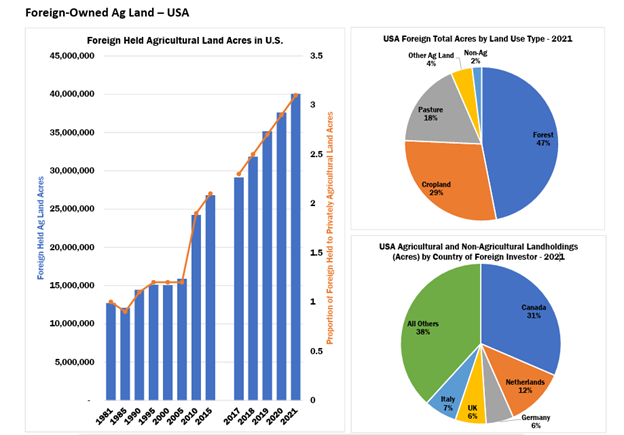
In recent years, the U.S. government has become increasingly concerned about foreign ownership of agricultural land. According to the most recent U.S. Department of Agriculture (USDA) report, foreign owners (primarily Canadian) hold an interest in nearly 45 million acres of U.S. agricultural land.
These concerns aren’t new. Since 1978, the Agricultural Foreign Investment Disclosure Act (AFIDA) has required disclosure of foreign investment in agricultural land. What is new is the rising number of states adopting laws that go beyond AFIDA, banning or limiting foreign investment in U.S. farmland.
This situation creates a distinct challenge for U.S. renewable energy developers, many of whom receive partial foreign funding yet depend on American farmland, such as dairy farms, for their project locations—and sometimes for feedstock as well.
Dairy farms are attractive to renewable energy project developers for several reasons. These farms offer open space to wind and solar developers, and feedstock to biogas projects. In addition, local, state, and federal laws often incentivize cooperation between farmers and developers to meet community energy demand.
Energy developers pursuing dairy-based projects with foreign funding should consider restrictions on foreign interests in U.S. farmland, especially in the top five dairy-producing states (California, Wisconsin, Idaho, Texas, and New York).
1) California
California has been the nation’s leading dairy state since 1993, when it surpassed Wisconsin in milk production. In 2021, the state produced 41.9 billion pounds of milk, more than 20% of the nation’s total production. Because of its highly developed low carbon fuels program, California is also a preferred market for renewable natural gas producers.
Foreign Ownership Restrictions
According to a 2020 USDA report, foreign investors own over 1.1 million acres of California agricultural land (nearly 4% of California’s privately held agricultural land), which is the ninth-highest amount among U.S. states.
California does not prohibit foreign ownership of land or farmland. According to Article I, § 20 of the California Constitution, noncitizens have the same property rights as citizens. And §671 of the California Civil Code establishes that any person, regardless of their citizenship status, may take, hold, and dispose of real or personal property within the state.
That doesn’t mean California hasn’t tried to restrict foreign land ownership. Introduced in 2022, Senate Bill 1084, the Food and Farm Security Act, sought to ban all foreign ownership of agricultural land in California and require the California USDA to report any foreign ownership of California land or resources. Governor Gavin Newsom vetoed the bill.
Energy Carveout
California does not have any foreign ownership restrictions, so energy carveouts do not apply.
2) Wisconsin
Wisconsin trails California in the dairy race. Yet dairy production is by far the largest agricultural sector in the state, generating $52.8 billion annually for the state’s economy.
Foreign Ownership Restrictions
Of Wisconsin’s privately held agricultural land, foreigners own 2.4%, or over 580,000 acres.
Unlike California, Wisconsin prohibits non-U.S. residents and non-U.S. corporations from holding any interest, directly or indirectly (except an interest used to secure repayment of debt incurred in good faith, e.g., a security interest in land given by a U.S. borrower to a foreign creditor), in more than 640 acres of land (whether agricultural, commercial, or otherwise) in the state (Wis. Stat. §§ 710.01 to 710.02).
However, proposed Assembly Bill 218 (AB 218), introduced in 2025, would further limit foreign ownership of real property. Assembly Substitute Amendment (ASA 1), which was introduced in August 2025, proposed a reduction of the 640-acre limit to fifty acres. In addition, the bill aimed to restrict foreigners from owning property within ten miles of military bases, as well as ban “foreign adversaries” (China, Russia, Iran, and North Korea) from owning any property in Wisconsin. The bill passed the Assembly but is pending in the House Agricultural Committee.
Energy Carveout
There are no exceptions for energy projects in Wisconsin foreign ownership laws.
3) Idaho
The third largest producer of dairy in the U.S., Idaho yielded 16.8 billion pounds of milk in 2021, accounting for 7% of the nation’s total milk production.
Foreign Ownership Restrictions
In Idaho, foreign investors own more than 120,000 acres of agricultural land, or .9% of Idaho’s privately held agricultural land.
As of 2023, Idaho restricts any foreign government or foreign state-controlled enterprise from purchasing, acquiring, or holding any controlling interest in agricultural land, forest land, water rights, mining claims, or mineral rights in the state (Idaho Code Ann. § 55-103).
In April 2025, the state further tightened its restrictions on foreign ownership through Senate Bill 1149 (SB 1149) and House Bill 356 (HB 356). SB 1149 added teeth to the 2023 law, authorizing the Idaho Office of the Attorney General to enforce the law. HB 356 updated the 2023 law to ban individuals, businesses, and governments from specific adversarial countries from acquiring Idaho agricultural, forest land, and related property rights. It also introduced new rules for divestment and disclosure.
Energy Carveout
Idaho’s foreign ownership laws contain no exceptions for energy projects.
4) Texas
Texas, while predominantly known for its beef cattle, produced 16.6 billion pounds of milk in 2023.
Foreign Ownership Restrictions
Foreign investors own more than 5.4 million acres of agricultural land in Texas, which equates to 3.4% of all private agricultural land in the state. And Texas is among the states with the largest Chinese holdings (123,708 acres).
Effective September 1, 2025, Texas S.B. 17 (Tex. Prop. Code Ann. § 5.005) prohibits foreign individuals or entities domiciled in counties designated as national security risks (including China, Russia, Iran, and North Korea) from acquiring interests in real property, including agricultural land. SB 17 creates a criminal offense and provides a civil penalty.
Energy Carveout
There is no energy exception to SB 17. However, this law does exempt short-term leases; meaning that there is no foreign restriction on owning or acquiring land with a leasehold of less than one year.
5) New York
Home to nearly 2,800 dairy farms in 2024, New York is the fifth largest dairy producer in the country.
Foreign Ownership Restrictions
Nearly 5% of all private agricultural land in New York is owned by foreigners (nearly 950,000 acres).
New York does not prohibit foreign ownership of land or farmland. According to N.Y. Real Prop. Law § 10, noncitizens have the same property rights as citizens.
However, Assembly Bill 3440 (A3440)–introduced in January 2025–would prohibit the acquisition or transfer of agricultural land by foreign adversaries after January 1, 2026. However, as of January 7, 2026, it was referred to the Assembly Judiciary Committee.
Energy Carveout
Currently, there is no foreign ownership restriction law in New York, and even if A3440 were to pass, A3440 does not have any carveouts for energy production.
Summary
| State | Existing Law Restricting Foreign Ownership of Agricultural Land | Proposed Law Restricting Foreign Ownership of Agricultural Land | Energy Carve-Out |
| California | No | Yes, but vetoed – AB 179 | N/A |
| Wisconsin | Yes – acreage restriction for all foreigners (Wis. Stat. §§ 710.01 to 710.02) | Yes – AB 218 (pending House Agri. Comm.) | No |
| Idaho | Yes – outright ban for all foreigners (Idaho Code Ann. § 55-103; SB 1149; HB 356) | No | No |
| Texas | Yes – outright ban for “designated countries” only (Tex. Prop. Code Ann. § 5.005) | No | No. But there is a short-term lease exception. |
| New York | No | Yes – A3440 (referred to Assembly Jud. Comm.) | N/A |
Conclusion
Foreign ownership of agricultural land is a hot button issue for renewable energy development on U.S. dairy farms, especially in the top-producing states of California, Wisconsin, Idaho, Texas, and New York. California and New York continue to allow foreign investment, but states like Wisconsin, Idaho, and Texas have enacted or proposed restrictions that make it more difficult for developers with foreign backing to access land for wind, solar, and biogas projects. With few energy‑specific carveouts available, developers and farmers must navigate a rapidly changing legal landscape to successfully plan and implement renewable energy projects.